In the fast-paced world of film and television, reading and analyzing scripts can feel overwhelming. Producers, directors, and writers spend countless hours dissecting dialogue, scene structure, and character development. Yet, even the most experienced readers can miss subtle details or unintentionally introduce bias. This is where an AI Script Reader steps in, transforming how scripts are evaluated, optimized, and prepared for production.
By leveraging AI Script Analysis, these tools deliver faster, more accurate insights while preserving the creative essence of storytelling. In this article, we’ll dive deep into AI Script Readers, exploring how they work, their features, real-world applications, and what the future holds for AI-assisted screenplay evaluation.
What Is an AI Script Reader?
An AI Script Reader is software that uses Artificial Intelligence (AI) and Natural Language Processing (NLP) to analyze, evaluate, and interpret screenplays. Unlike traditional script reading, which relies entirely on human judgment, AI provides objective, data-driven insights while still respecting the story’s creative intent.
At its core, an AI Script Reader performs several tasks:
- Script Processing – It interprets dialogues, scene descriptions, and character actions to build a structured understanding of the script.
- Natural Language Understanding (NLU) – AI comprehends context, tone, and relationships between characters and scenes.
- Named Entity Recognition (NER) – It identifies characters, locations, props, and key story elements automatically.
These capabilities allow AI to act as a virtual co-writer, editor, and evaluator, providing insights that were previously impossible to obtain without extensive human labor.
Key Features of AI Script Readers
Modern AI Script Readers come packed with features that help writers, producers, and studios streamline their creative process.
Automated Script Feedback
One of the most powerful features is automated script feedback. AI evaluates:
- Plot coherence and pacing
- Character consistency
- Dialogue clarity
- Scene effectiveness
This feedback is instant, helping writers iterate faster. For instance, AI can flag repetitive dialogue, suggest stronger character motivations, or indicate if a scene slows down the story’s pace.
Keywords integrated: Script quality AI checker, Automated script feedback
AI Script Scoring and Grading
AI Script Readers also provide scoring and grading to measure the overall quality of a script. These scores often consider:
- Dialogue effectiveness – Are characters’ lines engaging and authentic?
- Readability – Does the script flow naturally?
- Emotional impact – Does the narrative evoke the intended responses?
- Scene structure – Are setups and payoffs logically placed?
Some AI tools even compare your script against a database of successful films to provide predictive insights.
Keywords integrated: AI Script Scoring, AI screenplay grading
Script Summarization and Insights
Long scripts can be cumbersome to review. AI helps by summarizing scripts and extracting key insights. This includes:
- Condensed summaries of scenes or acts
- Character interaction analysis
- Major plot points and turning points
- Highlights of potential inconsistencies
This feature proves especially useful for producers, directors, and investors who need a quick yet accurate overview of a screenplay.
Keywords integrated: Script summarization AI, AI script insights
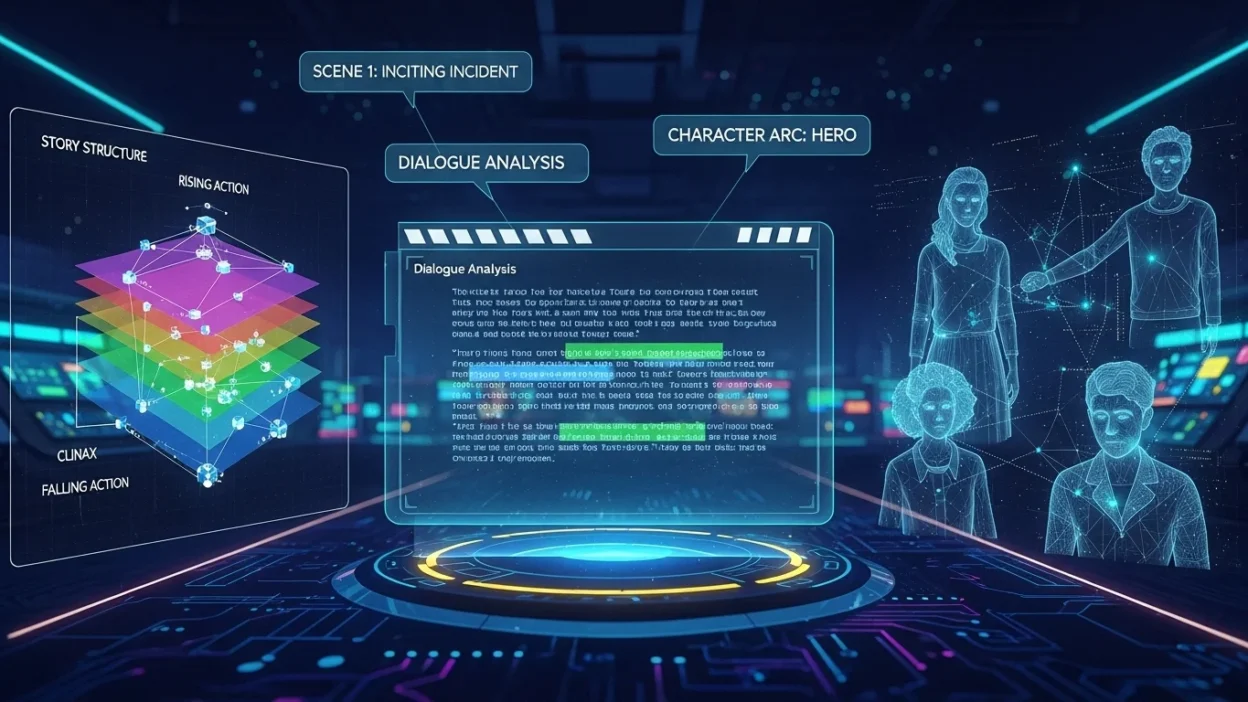
Story and Structure Analysis
AI tools excel at analyzing story arcs and structure. They can:
- Identify plot holes and inconsistencies
- Evaluate pacing and tension build-up
- Assess character development across acts
- Offer suggestions for more compelling story flow
By combining human creativity with AI precision, writers can refine their narratives faster than ever before.
Keywords integrated: Story structure analysis AI, AI story assessment
AI-Assisted Screenwriting Tools
Some AI Script Readers go beyond analysis and assist in writing itself. They:
- Suggest alternative dialogue
- Recommend scene adjustments
- Optimize pacing and readability
- Help maintain character voice consistency
This makes AI not just a reviewer but an active Scriptwriting AI tool that helps improve overall quality.
Keywords integrated: Scriptwriting AI tool, AI Script Assistant, Script optimization software
How AI Script Readers Work (Behind the Scenes)
Understanding what happens behind the curtain can help writers trust AI recommendations. Here’s a closer look at the process:
Tokenization
AI breaks the script into tokens, smaller units like words or phrases. This allows it to analyze structure and syntax efficiently.
Semantic Parsing
Next, the AI performs semantic parsing, converting raw text into structured representations. For example:
| Scene | Characters | Actions | Dialogue |
|---|---|---|---|
| 1 | Alice, Bob | Alice opens door | “What took you so long?” |
This structured format makes analysis precise and repeatable.
Context Extraction
AI identifies relationships between characters, events, and dialogue across the script. This ensures it understands context, not just isolated lines.
Sentiment Analysis
For scripts requiring emotional evaluation, AI can analyze the tone and mood of dialogue or scenes, helping writers balance tension, humor, and drama.
Language Modeling
Finally, AI uses language models to predict and suggest dialogue flow, scene transitions, and word choice, enhancing readability and narrative cohesion.
A diagram of the process might look like this:
Script → Tokenization → Semantic Parsing → Context Extraction → Sentiment Analysis → AI Insights
Benefits of Using AI Script Readers
Using an AI Script Reader comes with numerous advantages:
- Speed and efficiency – Evaluate scripts in minutes instead of days.
- Objective feedback – Removes human bias from script evaluation.
- Large volume handling – Analyze multiple scripts simultaneously.
- Storytelling insights – Identify plot weaknesses and strengthen character arcs.
- Collaboration support – Writers, producers, and editors can work together with AI-generated reports.
Example: A studio can scan dozens of submissions from a script competition and instantly identify the top 10 scripts based on scoring and readability analysis.
Use Cases of AI Script Analysis
AI script readers serve various roles across the entertainment industry:
- Film and TV Production Companies – Streamline script review pipelines, save time, and reduce costs.
- Independent Writers – Receive actionable feedback to refine scripts before submission.
- Content Studios – Extract data for adaptation, marketing, or investor pitches.
- Script Competitions – Provide unbiased scoring, ensuring fairness in evaluation.
Real-world statistic: According to a 2023 survey of 150 film studios, over 42% have started integrating AI tools for script evaluation and optimization.
Choosing the Right AI Script Reader
Not all AI tools are created equal. Consider these factors:
| Feature | Importance |
|---|---|
| Accuracy | Does it correctly identify context, characters, and plot points? |
| Script Scoring & Insights | Provides actionable recommendations beyond summaries. |
| Ease of Use | User-friendly interface for writers and producers. |
| Compatibility | Works with standard script formats (.pdf, .fountain, .docx). |
| Pricing | Offers affordable options for indie writers or enterprise-scale studios. |
Some popular tools include Final Draft’s AI add-ons, ScriptBook, and WriterDuet AI. Always test for accuracy and usefulness before full adoption.
Limitations and Challenges
While AI is powerful, it has limitations:
- Creative nuance – AI may miss subtle themes, humor, or irony.
- Over-reliance – Relying solely on AI can diminish human judgment and intuition.
- Ethical concerns – Issues around plagiarism, copyright, and bias must be addressed.
Tip: Use AI as a complement to human expertise, not a replacement.
Future of AI Script Readers
The future looks promising. AI is evolving to provide:
- Deeper semantic understanding – Evaluating subtext, symbolism, and thematic depth.
- Integration with screenwriting platforms – Offering real-time suggestions during writing.
- Predictive success modeling – Estimating audience engagement or box office potential based on script features.
Imagine a tool that predicts whether your script will resonate with audiences before it even hits production. That’s where AI is headed.
Conclusion
An AI Script Reader is more than a software tool it’s a partner for writers, producers, and studios. By combining speed, objectivity, and deep insights, it transforms the way scripts are read, analyzed, and optimized.
While AI cannot replace human creativity, it ensures your story is sharper, more engaging, and ready for production. Whether you’re an indie writer refining your first screenplay or a studio evaluating dozens of scripts, AI-powered script analysis is becoming an indispensable part of modern storytelling.