You are reading a science message in a group chat. Someone writes, “Na+ is a cation.” You stop for a moment. Cation? What does that mean? Is it slang? Is it a short form? Many students and social media users feel confused when they see this word.
it often appears in chemistry classes, textbooks, YouTube comments, and even WhatsApp study groups.
That is why many people search for cation meaning online. They want a clear and simple explanation.
If you also feel unsure, do not worry. This guide explains everything in very easy English so you can understand it quickly and use it correctly.
What Is the Meaning of Cation?
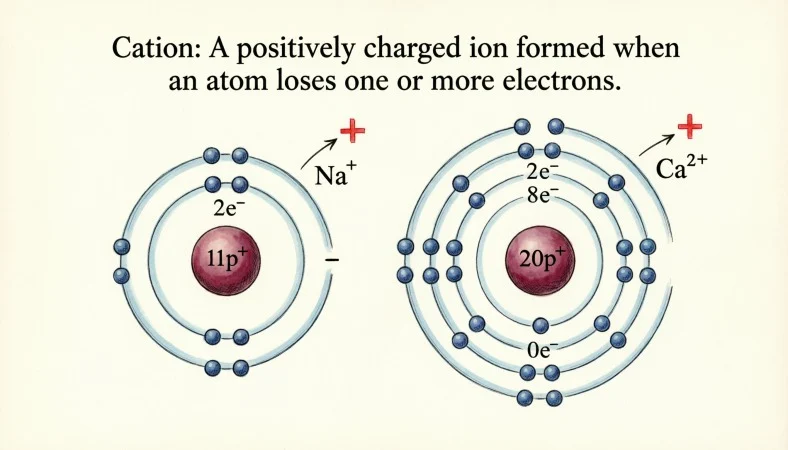
A cation is a positively charged ion.
It is an atom or molecule that has lost one or more electrons.
Because it loses electrons, it has more positive charge.
In simple words, a cation is a particle with a plus charge.
Understanding the Word in Simple Terms
Let us make it even easier.
Atoms normally have equal protons and electrons.
Protons are positive.
Electrons are negative.
When an atom loses an electron, the negative charge decreases.
So the atom becomes positive.
That positive particle is called a cation.
Think of it like this.
Lose a negative, become positive.
That is a cation.
Where Does the Word Cation Come From?
The word comes from Greek.
It means “to go down.”
Scientists gave this name because positive ions move toward the cathode in electrolysis.
You do not need to remember this for daily use.
Just know that cation means positive ion.
Cation Meaning in Chemistry
Chemistry students see this word often.
For example:
Na+ is a cation.
K+ is a cation.
Ca2+ is a cation.
Each one has a positive charge.
These particles play an important role in chemical reactions.
They help form ionic bonds.
They help create salts like sodium chloride.
Without cations, many chemical reactions cannot happen.
Examples of Common Cations
Here are some common cations you may see:
Sodium ion Na+
Potassium ion K+
Calcium ion Ca2+
Magnesium ion Mg2+
Hydrogen ion H+
All of these carry positive charges.
They are important in science and daily life.
How Cations Form
Formation happens when an atom loses electrons.
Let us take sodium as an example.
Sodium has 11 protons and 11 electrons.
When it loses one electron, it has 11 protons and 10 electrons.
Now it has one extra positive charge.
So it becomes Na+.
That is how a cation forms.
Cation vs Anion Difference
Many students mix up these two words.
Here is the simple difference:
Cation = positive charge
Anion = negative charge
Cations lose electrons.
Anions gain electrons.
Remember this trick:
Cation has a “t” that looks like a plus sign.
That can help you remember it is positive.
Why Cations Are Important
Life depends on cations.
Your body uses them every day.
Sodium and potassium help send nerve signals.
Calcium helps build strong bones.
Magnesium helps muscles work.
Without these positive ions, the body cannot function well.
Chemistry also depends on them.
They help form compounds.
They help balance charges.
They help electricity move in solutions.
Cation Meaning in Text or Chat
Sometimes students use this word in study chats.
Example:
A: What is Na+?
B: It’s a cation.
Another example:
A: Is potassium positive?
B: Yes, it forms a cation.
The meaning does not change in chat.
It always means a positive ion.
Is Cation a Slang Word?
No, it is not slang.
It is a scientific term.
People mostly use it in chemistry discussions.
You will not see it used as casual slang on Instagram or Snapchat.
It belongs to science language.
When Should You Use the Word Cation?
You can use it in:
- Chemistry class
- Science homework
- Study groups
- Lab reports
- Educational discussions
It is correct in academic settings.
When Should You Avoid Using Cation?
Avoid using it in:
- Casual daily conversations
- Jokes unrelated to science
- Professional talks outside science
- Social media posts not about education
The word may confuse people who do not study chemistry.
Real Life Examples of Cations
Table salt contains sodium cations.
Sports drinks contain potassium cations.
Milk contains calcium cations.
These positive ions support health.
Electric batteries also use ion movement.
Many cleaning products depend on ionic compounds.
So cations are not just in books.
They exist in everyday life.
Charge and Symbol of Cation
Cations always show a plus sign.
For example:
Na+
Ca2+
Al3+
The number shows how many electrons were lost.
If it says 2+, that means two electrons were lost.
If there is no number, it means one positive charge.
This system helps scientists understand chemical formulas easily.
Easy Way to Remember Cation Meaning
Here is a simple memory trick.
Cation sounds like “cat.”
Think of a cat with a plus sign.
Or remember this:
Cation = Positive
Anion = Negative
Short and simple.
Role of Cations in Ionic Bonding
Ionic bonds form between positive and negative ions.
A cation attracts an anion.
Opposite charges pull together.
For example:
Sodium cation Na+
Chloride anion Cl−
Together they form sodium chloride.
That is common table salt.
Without cations, ionic bonding cannot happen.
Cations in the Human Body
Your body contains many important cations.
Sodium helps control fluid balance.
Potassium supports heart function.
Calcium strengthens bones and teeth.
Magnesium helps muscle movement.
These positive ions keep your body working properly.
Doctors often check electrolyte levels.
Electrolytes include cations.
Balanced levels are very important for health.
Common Student Mistakes About Cation
Many students think:
Cation means negative.
Cation is same as atom.
Cation is slang.
All of these are wrong.
Cation always means positive ion.
It is different from a neutral atom.
It is not slang.
Understanding this clearly helps in exams.
Frequently Asked Questions
What is the simple meaning of cation?
It means a positively charged ion.
Is a cation positive or negative?
A cation is positive.
How does a cation form?
It forms when an atom loses electrons.
Is sodium a cation?
Yes, sodium forms Na+ which is a cation.
What is the difference between cation and anion?
Cation is positive. Anion is negative.
Is cation used outside chemistry?
Mostly no. It is mainly a science term.
Conclusion
Cation meaning is simple when explained clearly. A cation is a positively charged ion formed when an atom loses electrons. It plays a key role in chemistry, ionic bonding, and even human health.
You will often see this word in science classes, textbooks, and study chats. The term is not slang and is mainly used in academic settings.
Now you understand what a cation is, how it forms, and why it is important. This knowledge will help you in exams and in basic chemistry understanding.