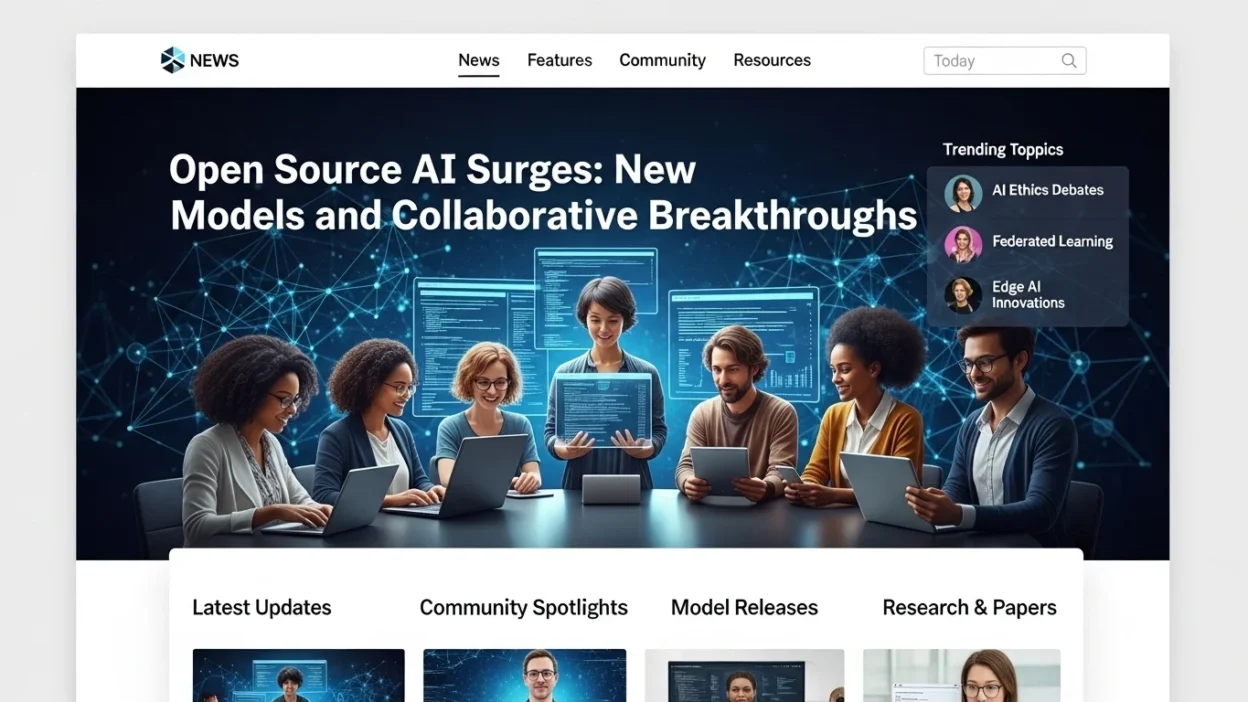
Open source AI isn’t just a tech buzzword—it’s revolutionizing how artificial intelligence is built, shared, and used worldwide. Every day brings new open-source tools, model releases, research breakthroughs, and community updates that developers, researchers, and businesses need to know.
From autonomous agents to multimodal AI frameworks, staying on top of open source AI news today is crucial for anyone looking to innovate or leverage AI effectively.
This article dives deep into the latest open source AI developments, the top tools, emerging trends, and insights that matter most in 2026.
What Is Open Source AI and Why It Matters
Open source AI refers to AI systems, models, and software whose source code is publicly available. Unlike proprietary software, open source AI allows anyone to inspect, use, modify, and distribute the code freely.
Benefits include:
- Transparency: Researchers and developers can see exactly how models work.
- Collaboration: Communities contribute to improvements, creating faster innovation.
- Accessibility: Startups, students, and independent developers can experiment without costly licenses.
- Customization: Organizations can adapt models for specific tasks or industries.
Open source AI has moved beyond experimentation. It’s now a mainstream driver of AI innovation, powering research, enterprise solutions, and new products.
Latest Open Source AI News Highlights
Here’s a roundup of the most recent and impactful open source AI developments as of March 2026:
Baidu Launches OpenClaw AI Agents
Baidu introduced OpenClaw, a suite of open-source AI agents that automate tasks from video editing to data analysis across multiple platforms, including cloud, desktop, and mobile. These agents integrate into Xiaodu smart devices and highlight China’s growing commitment to open AI ecosystems. (Reuters)
Key Features:
- Cross-platform automation
- Integration with smart devices
- Community-driven improvements
Nvidia Champions Open AI Collaboration
Nvidia launched the Nemotron Coalition, partnering with AI labs and platforms like Mistral AI and LangChain to develop open AI models. These models aim to balance transparency, customization, and performance. (WSJ)
Benefits:
- Faster development of specialized AI applications
- Improved governance and data security
- Community-driven open source contributions
Tranquility AI and Fivecast Partnership
Tranquility AI and Fivecast teamed up to accelerate open-source intelligence analysis for government and law enforcement. Their collaboration emphasizes actionable insights through open AI platforms, demonstrating how open source AI can support complex, real-world applications. (BusinessWire)
Mistral AI Introduces Leanstral
Mistral AI released Leanstral, an open-source framework designed for agentic workflows and trustworthy AI development. Leanstral strengthens the open source ecosystem by providing a foundation for autonomous agents and ethical AI practices. (Mistral.ai)
Nvidia Expands Open Models
Nvidia unveiled Nemotron 3 omni-understanding models, supporting AI agents capable of:
- Natural dialogue
- Advanced reasoning
- Sequential task execution
These models can operate across digital and physical environments, highlighting the growing capability of open source AI systems. (Nvidia News)
Open Source AI Outperforms Big LLMs in Research
Recent studies show that some open-source AI tools outperform large proprietary models in tasks like scientific literature reviews. These tools deliver accurate citations and structured analysis, proving that open source models are competitive with commercial solutions. (Nature)
AI Trends Shaping 2026
Experts identify several trends shaping open source AI in 2026:
- Security and governance for open AI systems
- Multimodal reasoning combining text, image, and video data
- Agent ecosystems enabling autonomous workflows
- Hybrid cloud-edge deployments for local control and privacy
(IBM)
Top Open Source AI Tools and Frameworks
Here’s a snapshot of essential tools actively shaping AI development in 2026:
| Tool / Framework | Purpose | Highlights |
|---|---|---|
| Hugging Face Transformers | NLP & LLM pipelines | Large model hub, community-driven |
| LLama 2 (Meta) | Open-weight LLMs | General-purpose language models |
| GPT4All | Local GPT-style models | Privacy-focused deployment |
| OpenLLaMA | LLaMA reimplementation | Performance improvements by community |
| LangChain | Agent & workflow framework | Automates chains of LLM tasks |
These platforms are powering chatbots, autonomous agents, research pipelines, and AI experiments worldwide.
Notable Open Source AI Models
Gemma Family (Google DeepMind)
- Gemma 3 is lightweight, multipurpose, and optimized for wide hardware compatibility.
OpenClaw Autonomous Agent
- Cross-platform, MIT-licensed agents that run locally for privacy.
- Capable of complex automation tasks and multi-application workflows.
Swiss Apertus LLM
- Fully open and multilingual AI model focused on transparency and EU compliance.
Emerging Trends in Open Source AI
Hybrid Agent Systems
Open source multi-agent frameworks automate complex tasks in research, materials design, and reasoning systems.
Collaboration Standards: MCP
The Model Context Protocol (MCP) is a new standard enabling AI models to communicate consistently across platforms, creating interoperability across open source tools.
Open Source AI in Research & Discovery
Open AI frameworks accelerate workflows in medical imaging, materials science, and automation, acting as partners in research rather than just tools.
Risks and Security Concerns
Open source AI growth comes with challenges:
- Security vulnerabilities: Malicious actors can exploit open agents.
- Regulatory uncertainty: Some governments restrict certain open AI tools for privacy reasons.
- Ethical risks: Misuse in surveillance, finance, or misinformation campaigns.
Responsible adoption and governance frameworks are essential to mitigate these risks.
How to Stay Updated with Open Source AI News
- Follow GitHub Repositories: Hugging Face, LangChain, OpenClaw, and other active repos.
- Subscribe to News Aggregators: Daily summaries of releases, model checkpoints, and research updates.
- Engage with Communities: Forums, subreddits, and Discord servers provide real-time insights and discussions.
Conclusion
Open source AI is no longer experimental. It drives innovation, collaboration, and transparency across industries. Today’s updates—from OpenClaw agents to Nemotron models—show how community-driven AI can compete with proprietary solutions.
Staying informed on open source AI news today ensures developers, researchers, and businesses can leverage new tools, trends, and models for better results. The future of AI is open, collaborative, and accelerating every day.

Michael Davis writes inspiring and heartfelt messages for readers at wishesfuel.com, creating modern, uplifting wishes that make every celebration memorable and meaningful with his warm, creative voice and captivating style.